+38 (098) 127 45 85
 +38 (050) 673 51 21
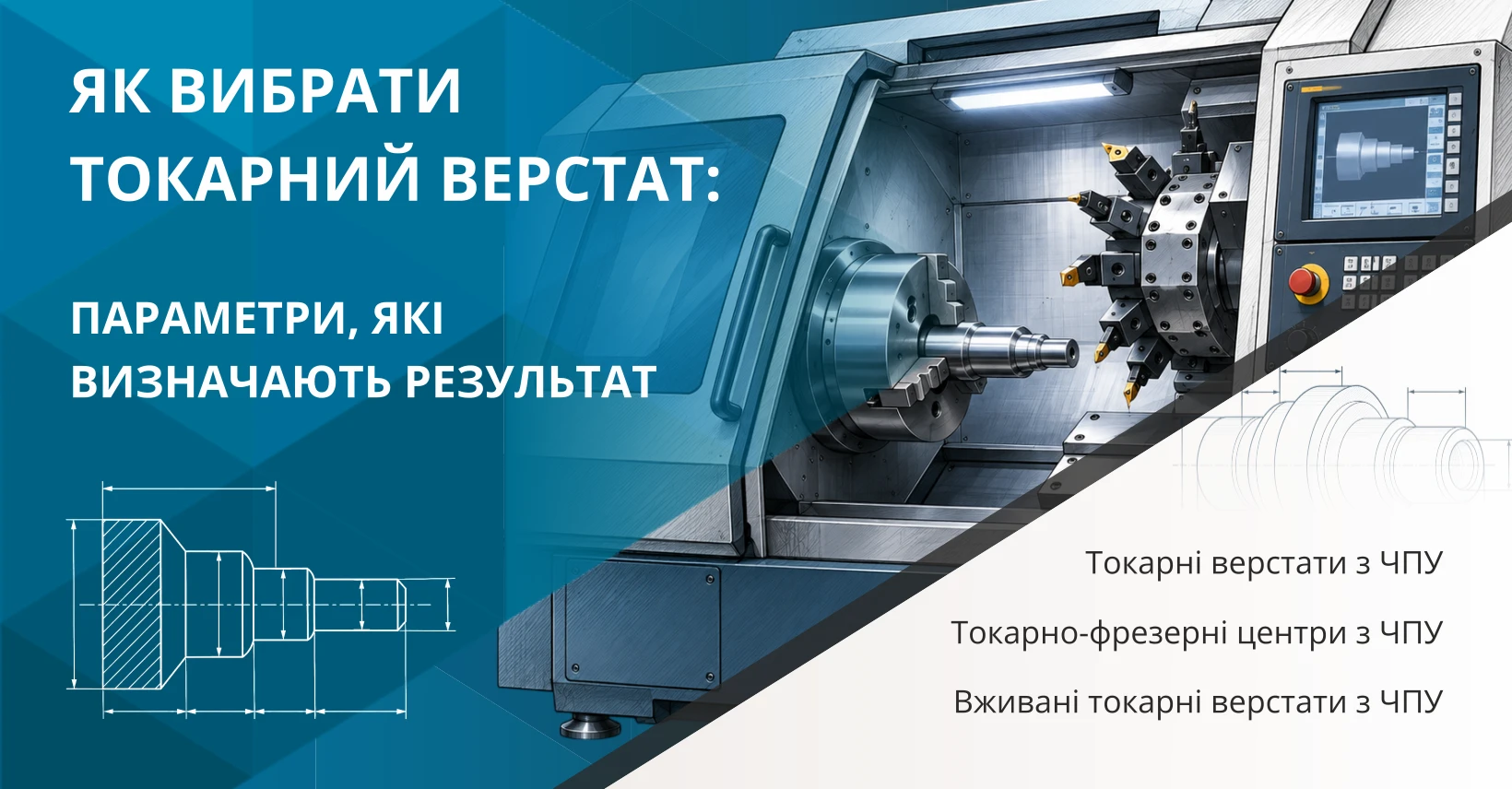
How to Choose a Lathe: Parameters That Determine the Result
How to choose a lathe for your production facility? First, you need to determine the dimensions of the workpieces, the material to be machined, the required accuracy, and the planned production volume. These parameters help identify equipment that matches the technological requirements of the manufacturing process.
Lathes are used to manufacture shafts, bushings, axles, flanges, and other rotationally symmetrical parts. Depending on their configuration, they can perform turning, drilling, boring, threading and, when appropriately equipped, milling operations.
Below, we examine the main selection criteria, the differences between CNC lathes and CNC turn-mill centres, as well as several examples of machines available from KVERB.
Which Lathe Should You Choose: Conventional or CNC?
Conventional lathes are suitable for repair work, one-off components, and small production batches. The operator manually sets the cutting parameters and controls the machining process.

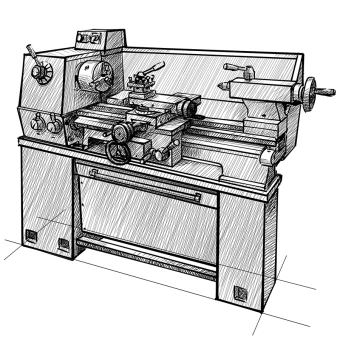
For machining large and long workpieces, KVERB offers the TOS SUI 63 conventional centre lathe. This Czech-made model has a swing over bed of 630 mm, a distance between centres of 3000 mm, and a spindle bore of 71 mm. The machine is designed for external and internal turning, facing, and thread cutting.

For workshops machining more compact parts, the WEILER Ergodor lathe can be considered. It is equipped with a digital readout, a Multifix tool holder, a three-jaw chuck, and automatic feed.
CNC lathes perform machining according to a programmed sequence, allowing operations to be automated and machining repeatability to be maintained when the equipment is in proper technical condition. They are widely used for parts with complex profiles and for serial production.
The choice between a conventional lathe and a CNC model depends on part complexity, setup frequency, the number of identical components, and the organisation of the production process.
How to Choose a Lathe Based on Technical Specifications?
How to choose a lathe based on its working parameters? The main factors to assess are the size of the working area, spindle characteristics, machining accuracy, and the capabilities of the tooling system.
Swing over bed determines the maximum workpiece diameter that can rotate above the bed without interference. The actual permissible machining diameter may be smaller depending on the machine design.
Distance between centres is important when machining long shafts and other components mounted between centres. On CNC lathes, the X- and Z-axis travels must also be considered.
Spindle bore determines whether bar stock can pass through the spindle. The maximum bar diameter also depends on the clamping system and machine configuration.
Spindle power, torque, and speed influence the available cutting parameters. Sufficient torque is particularly important when machining large workpieces, while smaller-diameter components may require higher spindle speeds.
Machining accuracy depends on the condition of the spindle assembly, guideways, machine rigidity, and correct tooling selection. On CNC machines, axis positioning accuracy and repeatability should also be taken into account.
All specifications should be evaluated together, because even a powerful machine with a large working envelope may not meet the requirements of a specific manufacturing process.
When Is a CNC Turn-Mill Centre Required?
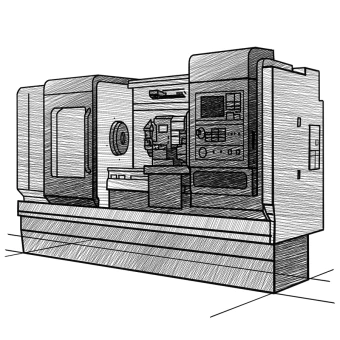
CNC turn-mill centres combine turning with additional drilling and milling operations. Depending on their configuration, they allow complex components to be produced with fewer workpiece re-clamping operations.
Such machines are suitable for production environments where components require slots, holes, threaded features, and other geometric elements in addition to conventional turning.
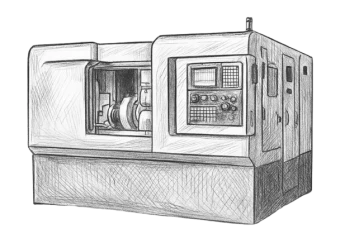
SMEC SL 2000SY — Turn-Mill Centre with Sub-Spindle

KVERB offers the SMEC SL 2000SY CNC turn-mill machine, manufactured in 2021.
The machine is equipped with a Siemens SINUMERIK 828D control system, Y and C axes, driven tooling, and a sub-spindle. The maximum turning diameter is 395 mm, while the main spindle speed reaches up to 6000 rpm.
The Y axis expands the machine's drilling and milling capabilities by enabling operations offset from the centreline of the workpiece. The sub-spindle allows machining to continue on the opposite side of the part, reducing the number of manual re-clamping operations.
SPINNER TTC 300 — Twin-Spindle Turn-Mill Centre

For production applications requiring machining from both sides of a component, the SPINNER TTC 300 twin-spindle turn-mill centre, manufactured in 2015, can be considered.
The machine is equipped with a main spindle and sub-spindle, two independent 12-position turrets, and a Siemens SINUMERIK control system.
The maximum machining diameter is 250 mm. The main spindle operates at speeds of up to 6000 rpm, while the sub-spindle reaches up to 7000 rpm.
The twin-spindle configuration makes it possible to machine components from both sides within a single production cycle. The ability to perform milling operations depends on the installed driven tooling and the specific machine configuration.
What Should You Check When Choosing a Used CNC Lathe?
Used CNC lathes can be an economically viable solution for companies planning to modernise or expand their production capacity. However, the actual technical condition of the machine must be evaluated carefully.
Before purchasing, check the condition of the spindle, guideways, drives, and control system. It is also important to confirm the machine's equipment package, documentation, operating hours, and maintenance history.
Particular attention should be paid to spindle operation at different speeds, backlash, and the condition of the tooling system. Whenever possible, a test cut should be carried out to verify the machine's operating condition.
The year of manufacture and nominal specifications provide useful information about the machine's capabilities, but the final decision should be based on its actual technical condition and the requirements of the intended production process.
Which Lathe Is Suitable for Your Production?
The appropriate model depends on the dimensions of the workpieces, part complexity, required machining operations, and planned production volume.
Production task | Recommended model |
|---|---|
Repair work and machining of large and long workpieces | |
Production of individual and compact components | |
CNC turning and milling operations | |
Twin-spindle machining of components |
The models listed above are represented in the KVERB catalogue. Before purchasing, their current availability, technical condition, and configuration should be confirmed.
Lathes from KVERB
How to choose a lathe for your company? Start by determining the dimensions of the workpieces, the required accuracy, production volumes, and the list of machining operations. This will help identify equipment that matches both your production requirements and available budget.
KVERB supplies conventional lathes, CNC lathes, and CNC turn-mill centres for metalworking companies. The company's specialists assist in selecting equipment according to the customer's technical requirements, required specifications, and machine configuration.
View used CNC lathes in the KVERB catalogue. Other available models, machine photos, and videos are published in the KVERB Telegram channel.
For consultation and assistance in selecting a lathe, contact the KVERB managers.
KVERB contacts:
+38 (050) 673 51 21
+38 (098) 127 45 85
info@kverb.eu
- Share
-

-

-

-

-

-